
Basement Flood Cleanup
A basement can take on water from above, from the side, or from below, and which one it was changes both the cleanup and what you do about it next. A burst pipe floods from above. Runoff and clay-soil seepage push through the walls. A rising water table, or a pump that quit, comes up through the slab.
Read the water before you touch it
| What you see | Likely source | Category | First move |
|---|---|---|---|
| Water spraying or running from a pipe or ceiling | Supply line or appliance | Category 1 at first | Shut off the water, then call |
| A damp line along the wall where it meets the floor | Seepage through the wall or a floor crack | Category 2 or higher | Keep the sump running, move belongings up |
| Water bubbling up through the floor drain or a toilet | Sewer or drain backup | Category 3 | Stay out, keep people and pets away, call |
| Water through the window wells and door threshold | Surface runoff after heavy rain | Category 2 or 3 | Do not walk in it, check where the downspouts empty |
| Water coming up through the slab after days of rain | High groundwater, sump pump overwhelmed or off | Category 2 | Check pump power and discharge line |
Why basements flood in this part of Maryland
Laurel sits on the Patuxent River's fall line, where hard Piedmont rock gives way to Coastal Plain sediments that include clay, as the Maryland Geological Survey describes the fall zone. Clay does not drain quickly. After a long rain, water collects against foundation walls and looks for a way in.
USDA soil descriptions for the Christiana and Beltsville series, both first described in Prince George's County, describe slow-draining ground: Christiana has a seasonal high water table within about 20 to 40 inches of the surface from November to April, and Beltsville has a fragipan at about the same depth. Your own lot may or may not have those soils, but the pattern is a familiar one: a wet spring, a saturated yard, and a basement that does not stay dry unless the sump is working. We go through this in more detail in a post on clay soil and basement seepage near the Patuxent.
What happens once we are in the basement
Water out
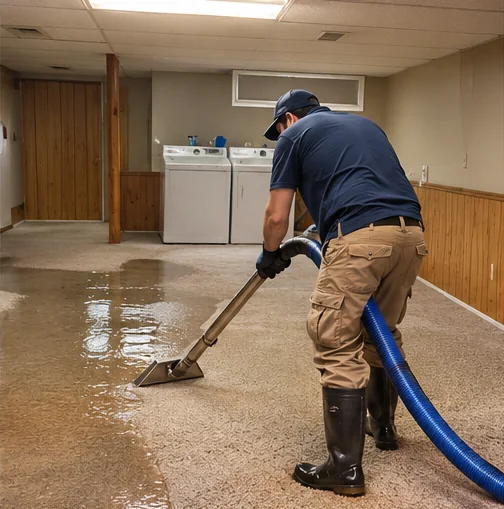
Pumps take down the depth and extractors clear the film from carpet and hard floors. If the sump pump is dead, a temporary pump is set to keep the basement dry while the cause is sorted out.
Contents out
Furniture and boxes are moved or lifted. Cardboard, upholstery and paper are usually lost if they sat in water. Hard goods can often be cleaned.
Material out
Wet carpet and pad, bottom feet of drywall, and soaked baseboard come out. A flood cut, often a foot or two above the water line, is done where wicking has gone up the wall.
Dry and clean
Drying equipment goes in. A dehumidifier does more here than fans, since basements are cool and the moisture tends to stay in the air and concrete.
Check
Readings on the slab, walls and framing are repeated until they match dry reference points.
Basement under water?
How deep is it, where did it come in, and is the sump pump running?
Call (301) 786-0888Finished and unfinished basements are different jobs
Unfinished
Concrete, block and exposed framing. These dry reliably, and the main work is extraction, cleaning and keeping humidity down so mold does not start on the stored belongings and joists.
Finished
Drywall, insulation, flooring and sometimes a drop ceiling. Water gets into the wall cavity and sits against the concrete behind it. Those cavities have to be opened or vented to dry, and soaked insulation is replaced.
Before we arrive
- If the basement has electrical outlets and the water is above them, do not go downstairs. Call the utility if you need power cut at the meter.
- Check that the sump pump has power, is not clogged and discharges outside.
- Carry out what you can reach safely from the top of the stairs, starting with electronics and papers.
- Leave the furnace and water heater alone. A technician checks them once the water is down.
- Photograph water lines on walls before they dry or are cleaned.
A dry floor is not a dry basement
A dry-looking floor after a flood is not a dry basement. Check for white powdery residue on concrete or block, which means moisture is moving through. Look at the bottom of the stairs, the base of the drywall and under the washer or water heater. A damp smell that comes back after cleaning, wet-looking paint on the lower wall and warped trim all point to water still in the structure.
Basement questions
My sump pump is running. Why is the basement still wet?
The pump may be undersized for the storm, the discharge line may be frozen or clogged, or the water is coming from somewhere the pit does not collect. Check that water is leaving the house, not looping back in.
Can I keep the carpet?
If the water was clean and the carpet was dried within a day or two, sometimes. If it was gray or black water, or the pad stayed wet, the carpet typically goes.
How do I stop it happening again?
Fix the grading so the ground slopes away, extend downspouts, keep gutters clear and test the sump pump before heavy weather. Interior drains and battery backups are options a plumber or waterproofing contractor can discuss.
How long will the basement be torn up?
Extraction and removal take a day or two. Drying runs several days after that. Rebuilding happens once readings are dry.
Does the water have to be gone before you start?
No. We start with the water that is there. Extraction is the first step.
Services that come next
- Emergency Water Extraction Pumps and extractors for deep water.
- Storm & Flood Water Cleanup When it was a storm that filled it.
- Sewage Backup Cleanup When it came up a floor drain.