
Serving Laurel, MD and Nearby Area
Frozen & Burst Pipe Cleanup in Laurel, MD
A frozen pipe usually shows its damage after the thaw, when the ice that held the line shut lets go. We pump out the water, remove what soaked through and dry the structure.
Call (301) 786-0888See pricing
- Basements, crawlspaces, exterior walls and hose bibs
- Extraction first, then removal and drying
- Moisture readings until the framing is dry
- Emergency calls taken 24 hours a day
Why pipes freeze and burst in Laurel, MD
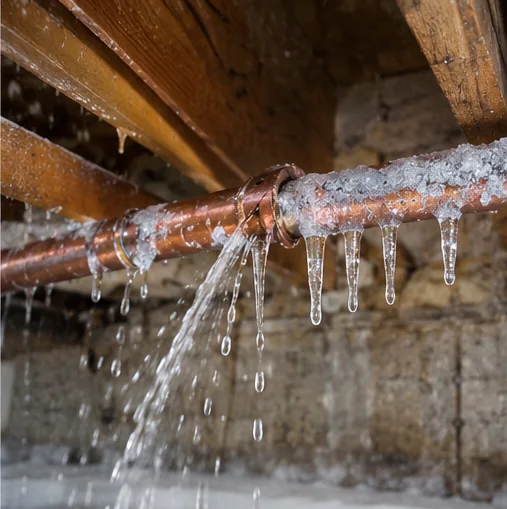
Water expands as it freezes, by roughly nine percent. That alone can split a pipe, but the more common failure is pressure. Ice forms a plug, water trapped between the plug and a closed faucet has nowhere to go, and the pipe gives way at its weakest point, often a joint or a thin spot in the wall of the line. The split can be a few feet away from the freeze itself.
That is why a house can sit through a cold night, look fine in the morning, and flood by afternoon as the pipe warms and the plug moves.
Where lines freeze in Laurel-area houses
Pipes in exterior walls
Kitchen and bathroom sinks on outside walls are the classic case. If the wall has thin insulation or gaps around the pipe, cold air from the outside reaches the line and the warm room air never does.
Crawlspace lines
Open vents and an uninsulated rim joist let wind run across supply lines under the floor. Older houses with a crawlspace or a partial basement are the usual suspects, since those spaces were often never sealed against winter air.
Hose bibs and spigots
A hose left attached in winter traps water in the pipe behind the wall. When it freezes, the split happens inside the house, and you may not see it until spring when the hose is turned on.
Garages, attics and porches
Any supply line running through space that is not heated is a candidate, including lines feeding a laundry room on an outside wall.
Freeze risk by location
| Where the pipe runs | Why it freezes | When to worry (rule of thumb) | What helps |
|---|---|---|---|
| Exterior wall | Little insulation between the pipe and the cold sheathing | Outdoor temperatures near or below about 20°F for several hours | Open the cabinet doors, keep heat on, insulate the wall |
| Crawlspace | Wind through vents and a leaky rim joist | Lower than that, sooner with wind | Seal gaps, insulate lines, block vent openings where the crawlspace allows |
| Hose bib | Water trapped in the stem inside the wall | Any hard freeze with a hose attached | Disconnect hoses, shut the interior valve, drain the line |
| Garage or attic line | Unheated space with no air movement control | Extended cold, especially with heat turned down | Insulate, add heat tape made for the pipe, keep doors closed |
| Interior wall, heated room | Rarely, only if the heat fails | When the house itself drops near freezing | Keep the heat on, even at a low setting, when away |
Found water after a freeze?
Shut off the main, then call. We start on extraction and drying while the plumber handles the pipe.
Call (301) 786-0888How frozen and burst pipe cleanup works in Laurel, MD
Confirm the water is off
The main shutoff comes first. We do not start drying a structure that is still taking on water.
Extract
Pumps and extractors take down standing water in the basement or crawlspace. Frozen-pipe water is usually clean at the start, which gives more material a chance to be saved.
Open and map
Moisture readings follow the water into walls and ceilings. Burst pipes in walls often soak the insulation and drywall from the inside, and we cut inspection holes to see how far it went.
Remove what has soaked through
Wet insulation and drywall come out. Wet carpet pad goes. Framing, subfloor and concrete are left to dry.
Dry and watch
Drying equipment runs until the readings match dry reference points. Winter air is dry, but the house is also closed up, so moisture has to be pulled out on purpose.
Do this before we get there
- Shut the main water valve. Know where it is before winter, not during the flood.
- Open the faucets on the damaged line to drain what is left in it.
- If the line is still frozen, do not use a torch or an open flame. A hair dryer or warm towels is safer.
- Keep the heat on so the rest of the house does not freeze too.
- Photograph the break and the wet areas for your insurance company.
Signs of water you have not found yet
After a thaw, check for water in places you do not look every day: the back of a closet on an outside wall, the ceiling under a bathroom, the crawlspace after a warm spell, and the wall behind the washing machine. A sudden rise in the water bill, the sound of water running when nothing is on, and a ceiling that sags overnight all point to a pipe that is leaking where you cannot see it.
How much does frozen and burst pipe cleanup cost?
A burst pipe can mean a wet closet or a flooded basement, so the price swings widely. The numbers below are estimated ranges for typical pieces of the cleanup. They are not final prices, and the price for your house is set after we see the damage and take moisture readings. The plumber's repair of the pipe itself is separate.
| Service | Estimated range | What it covers |
|---|---|---|
| Emergency water extraction, basement or crawlspace | $800 to $2,500 | Pumps and extractors on standing water, one visit |
| Small break, one room, extraction through drying | $1,000 to $3,500 | Water out, a little removal, a few days of drying |
| Larger break, finished basement or several rooms | $3,500 to $9,000 | More area, wet carpet and drywall, more drying days |
| Wet insulation and drywall removal after a wall or ceiling break | $1,000 to $4,000 | Cutting out what soaked through and hauling it away |
| Crawlspace water removal and drying | $1,500 to $6,000 | Pumping, insulation removal, slow drying in a tight space |
| Drying equipment and daily readings | $1,000 to $3,500 | Air movers, dehumidifiers and monitoring until dry |
What moves a freeze-break price up or down:
- How long the water ran before the main was shut off.
- Where the pipe is. A break in an open crawlspace is simpler than one inside a finished wall or ceiling.
- Finished or unfinished space. Carpet, drywall and trim add removal and drying.
- Floor area that is actually wet.
- Drying days, which run longer in a closed-up winter house and in thick framing.
- Water category. Supply-line water starts clean, but it can move up a category if it sits.
- Access, such as tight crawlspaces or cabinets in the way.
For ranges on other kinds of water damage work, see the pricing page. Insurance coverage for a freeze break depends on your policy, as the post on homeowners insurance and water damage in Maryland explains.
Frozen and burst pipe cleanup questions and our answers
Does it count as a burst pipe if it only leaks a little?
Yes. A hairline split can soak a wall for days. Slow leaks are often more damaging than loud ones because nobody notices until the drywall softens.
Should I thaw a frozen pipe myself?
If you can see it and nothing has split, warming it slowly with a hair dryer is fine. If there is any water coming from it, stop and shut off the main.
Will the pipe freeze again?
It can. A repaired pipe in the same cold spot has the same problem. Insulation, sealing air gaps and moving the line are the lasting fixes, and a plumber can advise on which.
How long does drying take after a freeze burst?
Usually a few days for a small area, longer if the water went into a finished basement ceiling or deep into wall cavities. The readings decide when equipment comes out.
Is the water clean?
Water from a supply line is clean when it leaves the pipe, and it is Category 1 at first. It becomes Category 2 if it sits and picks up dirt, so speed counts.
More on winter breaks
- Basement Flood Cleanup When the pipe flooded the basement.
- Crawlspace Water Removal & Drying When the break was under the house.
- Structural Drying & Dehumidification How wet walls and floors are dried.