
Structural Drying & Dehumidification
Dry is a number. A floor that feels dry can still carry moisture in the subfloor, and a wall that looks fine can hold water in the cavity behind it. Structural drying is the part of a water loss where those numbers are taken down, day by day, until the building matches the parts of it that never got wet.
How long does it take? Factors that move the clock
| Factor | Speeds drying | Slows drying |
|---|---|---|
| Material | Drywall, thin carpet, open framing | Hardwood, plaster, concrete, dense insulation |
| Water category | Clean water caught early | Contaminated water that requires material removal first |
| Time before action | Dried within a day | Water sat for several days |
| Air and temperature | Warm air that can hold moisture, good airflow | Cold basement, closed room, high outdoor humidity |
| Access | Open wall cavities, removed baseboard | Cabinets, built-ins, two layers of flooring |
| Area wet | A single room | Multiple rooms or floors |
The equipment, and what each piece does
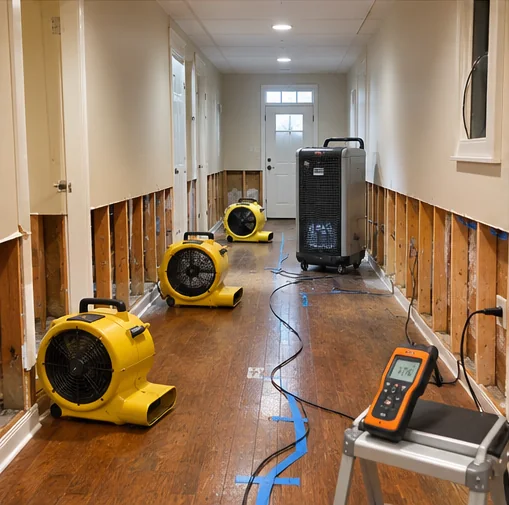
Air movers
High-velocity fans set low to push air across wet surfaces. They speed up evaporation at the surface. They do not remove moisture from the room, which is why they never run alone.
Dehumidifiers
These pull the moisture out of the air. A low-grain refrigerant unit is the common choice. In cold spaces, a desiccant dehumidifier may do a better job because it does not depend on a cold coil.
Cavity and floor drying systems
Hoses and ports that push or pull dry air through wall cavities or beneath hardwood floors. They reach moisture that surface fans cannot.
Moisture meters and a log
Meters read moisture content in drywall, wood and concrete. Readings go on paper or a device with the date, location and the numbers.
How a drying job runs
Set targets
Readings are taken in unaffected parts of the building, a dry wall in the same house, for example. Those become the dry standard for each material.
Place equipment
Air movers go on wet surfaces, dehumidifiers are sized to the room and class of loss, and doors are closed to keep the drying zone contained.
Monitor daily
A technician re-reads the same locations, moves equipment and removes anything that has reached its target.
Adjust
A wall cavity that has not budged gets an opening or a drying port. A floor that cups gets a mat system.
Confirm and remove
When the wet materials match the dry standard, the equipment is removed, and the numbers are recorded.
Why hardwood, plaster and concrete take longer
Dense materials hold water tightly and let it go slowly. A hardwood floor soaks up moisture through the underside and cups as it does. Plaster and concrete are porous, but water moves through them at a crawl. These are the materials the standard calls Class 4, and they are dried with focused equipment and patience. Rushing them with heat can crack the surface or lock moisture in below it. The better approach is steady airflow, controlled humidity and daily readings until the numbers come down.
Wet structure, not sure it is drying?
We can take readings and tell you whether the equipment on site is doing its job.
Call (301) 786-0888What you will notice at home
- Noise, steady and constant, for several days.
- A warm house, because dehumidifiers give off heat.
- Hot, dry air in the drying zone and a slightly higher electric bill.
- Doors and windows kept closed, which is the opposite of what feels natural.
- Visits every day or two to check readings.
What to do while equipment is running
Leave the machines running and leave the settings alone. Do not unplug one because it is loud at night or because you need the outlet for a vacuum. Keep the doors to the drying room closed. If a machine stops or a breaker trips, call us. Keep pets and children away from the cords, and tell us if a power strip or extension cord is part of the setup.
Signs that drying is not working
A musty smell that returns after day three, damp-feeling walls, paint that bubbles after it seemed fine, baseboards that stay cold to the touch, and readings that stop falling are all warnings. A common cause is a wet cavity nobody opened. Another is equipment pulled too soon because the room felt dry. We recheck, open what has to be opened and adjust the equipment. Cutting the job short is how a water loss turns into a mold job.
Drying questions
Why do you need so many machines?
Each room has its own volume and moisture load. Air movers cover wet surfaces, and dehumidifiers are sized to the air they have to dry. More wet area means more equipment.
Can I just open the windows?
In humid weather, outside air adds moisture. Drying works best in a closed space with controlled equipment.
Is it normal for the room to feel warm?
Yes. Dehumidifiers add heat to the room, and warm air holds moisture, which helps the drying.
How do you know when to stop?
When readings in the wet materials match the dry standard taken from unaffected materials, with margin. Feel and smell are not enough.
Will the equipment damage my floors?
Not when it is placed with care. Machines sit on pads or clean surfaces, and we ask about any floor you are worried about. The bigger risk to a wet hardwood floor is leaving it wet.
Other pieces of the same job
- Water Damage Restoration Where drying fits in the larger job.
- Crawlspace Water Removal & Drying Drying in tight spaces.
- Basement Flood Cleanup Drying after a flooded basement.